
You work with fabrics, source materials, or simply want to understand how color sticks and the textile world uses a defined set of dye types to do that. The main dye classes reactive, acid, disperse, vat, direct and sulfur (plus pigments and natural dyes), determine which fibers you can color, how durable the shade will be, and what processes and environmental controls you’ll need.
This article breaks down dye classifications, explains the major dye types used for cotton, wool, silk, polyester and blends, and highlights specialized or emerging dyes changing production quality and sustainability. Expect clear guidance to help you choose the right dye approach for your fabrics and objectives.
Classification of Textile Dyes
This section breaks down dye classes by origin, chemical nature, and bonding mechanism so you can select dyes based on fiber type, fastness needs, and processing steps. It highlights practical differences that affect fixation, washfastness, and machinery requirements.
Natural Dyes vs Synthetic Dyes
Natural dyes come from plants, animals, and minerals, examples include indigo, madder, and cochineal. You must mordant many natural dyes (e.g., alum, iron) to improve fixation and colorfastness; this adds processing steps and can change shades.
Natural dyes often give softer, less uniform shades and are preferred where heritage, sustainability, or specific hand feel matter.
Synthetic dyes are manufactured from petrochemical or biochemical feedstocks. They provide consistent shade reproducibility, broader color ranges, and higher fastness properties for industrial-scale production.
You choose synthetic dyes when you need strong wash- and light-fastness, economical large-batch matching, and compatibility with automated dyeing equipment.
Organic and Inorganic Pigments
Organic pigments are carbon-based molecules (azo, phthalocyanine families) that deliver bright, saturated colors. You apply them mainly as pigment pastes with binders for surface coloration (e.g., pigment printing) rather than fiber-internal staining.
They resist fading from light but require robust fixation systems to maintain rub and wash fastness when used on textiles.
Inorganic pigments are mineral-based (e.g., titanium dioxide, iron oxides) used for opaque whites, blacks, and earth tones. They offer excellent lightfastness and thermal stability.
Both pigment types do not chemically bond to fibers; you must use binders, resins, or surface treatments to achieve durable attachment and acceptable hand feel.
Reactive and Substantive Dye Types
Reactive dyes form covalent bonds with fibers, especially cellulose (cotton, viscose). You get excellent washfastness and bright shades, but reaction conditions (alkali, temperature) and careful salt/alkali control are necessary.
Reactive dyes suit continuous and batch processes; you must manage effluent chemistry to reduce unfixed dye loss.
Substantive dyes (direct, vat, and disperse categories by mechanism) rely on physical affinity or reduction-oxidation cycles.
- Direct dyes attach by hydrogen bonding and van der Waals forces; they dye cotton without strong chemical bonds but need leveling agents and often show moderate washfastness.
- Vat dyes (e.g., indigo) require reduction to a soluble leuco form to penetrate fibers and re-oxidation to insoluble form; they give superb washfastness on cellulosics.
- Disperse dyes are finely ground nonionic particles used on hydrophobic fibers (polyester); they dye by diffusion at elevated temperatures or under carrier/solvent systems.
Major Dye Types Used in the Textile Industry
You will find dyes that differ by fiber compatibility, fixation chemistry, and processing requirements. Each type below shows typical fiber targets, application method, colorfastness strengths, and primary limitations.
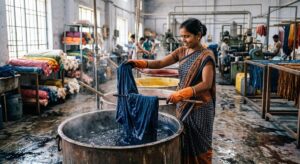
Reactive Dyes
Reactive dyes form a covalent bond with cellulose and other hydroxyl-containing fibers, so they deliver strong wash and light fastness on cotton, viscose, and some silk blends. You apply them in an alkaline bath (usually with sodium carbonate) at moderate temperatures; the dye reacts chemically with the fiber rather than just adhering physically.
Benefits include bright shades, good wet-fastness, and relatively straightforward exhaust dyeing or continuous pad-steam processes. Limitations are salt and alkali use, potential water load in rinsing, and sensitivity to improper fixation that causes poor washfastness or high unfixed dye in effluent.
Key practical points:
- Best for cellulosic fibers and some protein blends when pretreated.
- Common reactive classes: vinylsulfone, monochlorotriazine, bifunctional types for improved fixation.
- Control fixation time, pH, and temperature to minimize hydrolysis and dye loss.
Disperse Dyes
Disperse dyes are non-ionic, low-solubility dyes used primarily for hydrophobic fibers like polyester, acetate, and nylon in some cases. You apply them from a finely ground dispersed suspension; high-temperature thermosol or carrier-assisted dyeing promotes dye diffusion into the polymer matrix.
They provide excellent color depth and good lightfastness on synthetic fibers. Challenges include the need for dispersion stabilization, high-energy dyeing (HT at 130–140°C) or use of carriers at lower temperatures, and potential environmental concerns with carriers and micro-dispersed dye particles.
Practical considerations:
- Use carrier or HT dyeing for polyester; thermosol gives shorter cycle and good fixation.
- Particle size control and dispersion agents are critical for even shade and leveling.
- Post-dye washing/rinsing removes surface-dispersed dye to improve fastness and reduce effluent load.
Direct Dyes
Direct dyes are water-soluble anionic dyes applied directly to cellulosic fibers from aqueous baths without a reactive fixative. They attach via hydrogen bonding and van der Waals forces, making them simple to use for low-cost, medium-fastness applications.
You get good brightness and easy application for woven and knitted cotton, rayon, and paper, but wash and wet rub fastness are weaker compared with reactive or vat dyes. Salt and electrolytes often assist exhaustion; leveling agents and aftertreatment (cations or resins) can improve wet-fastness.
Operational notes:
- Best where economy and ease matter over high washfastness, home textiles, basic apparel, and some industrial fabrics.
- Use salt to promote exhaustion and fixatives or softeners post-dye to raise wet-fastness.
- Not recommended where heavy laundering or chlorine is required.
Vat Dyes
Vat dyes provide outstanding wash and light fastness on cellulosic fibers by undergoing a reversible chemical transformation: insoluble dye is reduced to a soluble leuco form, applied to the fiber, then oxidized back to the insoluble dye inside the fabric. Indigo and many high-fastness blues and blacks fall into this class.
They excel where durability matters, workwear, denim (indigo), and outdoor textiles—but require reductive vatting (e.g., sodium hydrosulfite or thiourea dioxide), careful pH control, and thorough oxidation. Processing is more complex and often costlier than for reactive or direct dyes.
Essential tips:
- Ideal for garments requiring long-term color retention and abrasion resistance.
- Manage reductant dosage, pH, and oxidation time to prevent uneven shade or residual leuco loss.
- Consider environmental controls for reducing agents and rinse effluent to meet compliance.
- Specialized and Emerging Dyes in Textiles
These dyes target specific fiber types, performance needs, and environmental goals. You’ll see choices that improve washfastness, enable bright shades on protein fibers, or reduce ecological impact through new chemistries and processes.
Acid Dyes
Acid dyes bond ionically to protein and polyamide fibers, making them the primary choice for wool, silk, and nylon. You’ll use them when you need vivid, level shades on these substrates because their anionic sulfonate groups interact with protonated amine sites on the fiber.
Control of pH and temperature determines shade depth and fixation. Typical dyeing occurs in mildly acidic baths (pH 3–5) at 80–95°C for nylon and lower temperatures for silk and wool to avoid damage.
Expect good wet‑fastness and a wide color range, but limited lightfastness for some shades. You can improve fastness with mordants, after‑treatments, or selecting metal complex acid dyes for deeper, more durable colors.
Basic Dyes
Basic dyes (cationic dyes) give extremely bright, intense colors on acrylics, paper, and certain modified nylons. You’ll choose them for neon tones and for dyeing acrylic knits where other classes struggle to achieve comparable brilliance.
They bind through electrostatic attraction to anionic sites in the fiber; exhaustion requires finely controlled liquor ratios and leveling agents to avoid streaks. Fastness to washing can be weak on some substrates, so you’ll often apply cationic fixing agents or heat treatments to improve wash and rub performance.
These dyes also work in printing and stamping because of rapid uptake, but you must manage bleeding and migration during finishing. For light and chemical resistance, opt for basic dyes designed with extended conjugation or additional substituents that boost stability.
Azo Dyes
Azo dyes form the largest synthetic dye class, defined by one or more –N=N– azo linkages. You’ll encounter them across fibers, cotton (direct/reactive derivatives), wool and silk (acid derivatives), and synthetics (disperse variants), because they offer broad color ranges and cost efficiency.
Synthesis allows structural tuning for hue, solubility, and fastness. You can select monoazo for bright yellows and oranges or disazo/extended systems for deeper reds and browns. However, some aromatic amine byproducts pose regulatory and health concerns; you must ensure suppliers certify freedom from banned amines and comply with local regulations.
Process control during dyeing and finishing affects migration, fixation, and environmental release. You’ll often pair azo dyes with appropriate fixing agents, advanced rinsing, and wastewater treatment to meet compliance and performance targets.
Eco-Friendly Dye Innovations
Sustainability trends push adoption of low‑impact chemistries, closed‑loop processes, and bio‑based dyes. You can choose reactive dyes with improved fixation rates to reduce effluent COD, or use enzyme-assisted dyeing to lower temperature and chemical demand.
Natural and bio‑engineered dyes (microbial pigments, plant extracts refined for consistency) offer lower toxicity and biodegradability, but you must validate fastness and batch reproducibility for commercial runs. Emerging carriers and supercritical CO2 dyeing eliminate aqueous effluent for many hydrophobic dyes on polyester, cutting water use dramatically.
Look for certifications (OEKO‑TEX, GOTS, Bluesign) and supplier data on lifecycle impact when adopting innovations. Combining process changes, better fixation, wastewater recovery, and alternative dye classes, gives the most reliable path to reduced environmental footprint without sacrificing quality.